Restaurants and bakeries lose money when wrapping material arrives late, fails with hot or oily food, or appears cheap until freight and waste are counted. By the end, you will be able to calculate a practical order quantity, compare rolls with sheets and cases, test a sample, and decide whether a bulk wholesaler order fits your operation.
Key takeaways
- Use four weeks of consumption to estimate lead-time demand.
- Compare usable sheets and landed cost, not carton weight alone.
- Request food-contact documents and test paper on your actual workflow.
- Set storage, reorder, and contract rules before buying in bulk.
Calculate how much butter paper you can use before ordering in bulk
Order enough butter paper for your actual usage during the supplier lead time plus a small safety reserve, not simply the largest carton available. Start with restaurant packaging inventory or bakery packaging consumption records from the past four weeks.
1. Count average daily usage. Divide sheets, wrappers, or metres issued by the number of operating days. If one item uses 0.35 metres and you sell 800 items weekly, weekly demand is 280 metres.
2. Add waste. Record miscuts, torn sheets, trimming, rejected wraps, and paper damaged during handling. Your paper wastage calculation is wasted quantity divided by total quantity issued; add that percentage to the usable demand.
3. Add lead-time cover. Multiply adjusted daily demand by the number of days between placing an order and receiving it. Add a reserve of 7 to 14 days if deliveries are inconsistent or demand changes sharply.
4. Check storage capacity before bulk butter paper purchasing. Compare the calculated quantity with the number of cartons or rolls you can keep dry, off the floor, away from ovens and steam, and in the original packaging.
5. Set a reorder point. Divide the reserve quantity into a weekly target and reorder when stock reaches lead-time demand plus that reserve.
Issue older stock first. A cheaper bulk order becomes waste when moisture causes curl, stiffness, feeding faults, or damaged packaging before you can use it.
Compare usable paper and landed cost, not the package label
A low price per kilogram proves little if the roll is too wide for your tray or cutting layout. Calculate the delivered price, then divide it by the paper that actually becomes a usable wrap, liner, or sheet.
| Buying format | Compare this figure | Common trap |
|---|---|---|
| Roll | Landed cost per usable square metre | Trim waste, splices, curl, and unsuitable width |
| Kilogram | Landed cost ÷ usable square metres, using actual basis weight | A heavier grade appears expensive per kilogram but may perform better |
| Sheet pack | Cost per usable sheet | Short counts, damaged edges, and unsuitable dimensions |
| Case | Total case cost ÷ usable sheets or packages | Inner packs, conversion charges, and unusable stock |
For a roll, multiply width by length to find supplied square metres, then subtract the percentage lost in trimming, setup, rejected pieces, and damaged material. For sheets, divide the pack price by the count you can actually use.
A case containing 10 packs of 500 sheets is 5,000 sheets only if every sheet meets your size and handling requirements.
Your butter paper price comparison must include freight and GST packaging cost, cutting, packing, minimum-order charges, and delivery damage. Compare the same paper construction and basis weight. A converted sheet can cost more per square metre yet save labour and feeding failures; a jumbo roll can look cheaper while creating waste and tying up cash.
Use both cost per usable sheet and cost per square metre. The first suits standard portions; the second exposes whether different widths and lengths are being compared fairly. The lower number is the genuine saving only after your workflow’s waste is included.
Match the format and paper construction to the food and workflow
Choose rolls for high-volume wrapping or a machine that cuts on demand; choose sheets when staff need fast, consistent packing at a service counter. Butter paper rolls versus sheets is a workflow decision: rolls reduce unit packaging and suit standard widths, while sheets reduce cutting labour and mistakes.
| Format or construction | Best fit | Check before ordering |
|---|---|---|
| Roll | Continuous wrapping, automated cutting, high volume | Slit width, core size, roll length, and trim waste |
| Pre-cut sheet | Counter service, takeaway orders, varied staff workflows | Sheet dimensions, stack count, and bakery tray paper size |
| Greaseproof or parchmentized paper | Dry or moderately oily foods | GSM and grease resistance, not GSM alone |
| Wax or polymer-coated paper | Stronger moisture or grease barrier | Coating, sealability, heat limit, and food-contact declaration |
| Aluminium-foil laminate | Light-, oxygen-, moisture-, or aroma-sensitive foods | Foil thickness, bond, pinhole limit, seal method, and use temperature |
For burger and sandwich wrapping paper, specify the finished width and length against the item, fold pattern, and closure method. An oversized sheet raises cost and waste; an undersized sheet exposes food and slows packing.
“Butter paper” does not identify the construction. Dense greaseproof paper may resist oil better than a heavier sheet, while a foil laminate can fail at a fold, seam, pinhole, or weak paper-to-foil bond.
Request the lot number, basis weight, caliper, coating or laminate details, and food-contact declaration so you can isolate a defective lot instead of rejecting the entire order.
Qualify the wholesaler with a sample, documents, and a handling test
Verify the material, paperwork, and performance with your own food before committing to a large order. “Butter paper” can mean machine-glazed greaseproof paper, parchmentized paper, wax-coated paper, polymer-coated paper, or aluminium-foil laminate; these constructions behave differently under heat, grease, moisture, and sealing.
1. Request a representative sample from the proposed production lot. Conduct butter paper sample testing with your hottest, oiliest, or most liquid product, using the actual contact time and wrapping method. Check for staining, seepage, tearing, sticking, odour transfer, and seal failure after cooling.
2. Ask for the TAPPI T 559 grease resistance result and the test construction. The numbered score is useful for comparison, but it does not prove suitability for every food or temperature. Do not substitute GSM for a grease-resistance requirement; a heavier sheet can still leak.
3. Demand a lot-specific document pack: basis weight, caliper, coating or laminate description, production-lot number, and food-contact compliance declaration. For US-bound packaging, check whether the intended food falls under 21 CFR 176.170 or 21 CFR 176.180.
4. Request a current PFAS declaration for paper packaging covering intentionally added PFAS chemistry, and obtain analytical confirmation if your policy requires it. “Food-safe” alone is not enough.
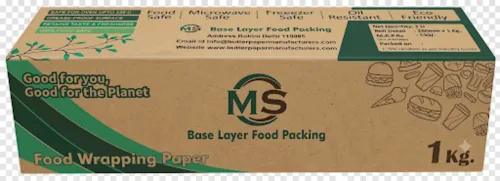
Baselayer Food Packing should be assessed against this same checklist, particularly when comparing rolls, sheets, or customised cuts. Reject samples that shed fibres, smell strongly, curl into unusable shapes, or arrive without traceable lot identification.
Set storage, replenishment, and contract rules that protect the saving
Protect the saving by making storage rules and supplier obligations part of the purchase decision. Keep butter paper storage in the original protective packaging, on pallets or shelving, away from ovens, steam, direct sunlight, and damp walls. Moisture changes can cause curl, stiffness, dimensional variation, and poor feeding.
Run a FIFO packaging inventory: mark each carton or roll with its receipt date and issue the oldest usable lot first. Set a reorder point based on average weekly consumption, supplier lead time, and one defined emergency reserve.
Do not accept a minimum order quantity that exceeds your storage capacity or the quantity you can use before paper quality declines.
Put these protections in a bulk packaging supply contract:
- State the slit width, core size, roll length, sheet dimensions, basis weight, caliper, coating or laminate construction, and grease-resistance performance.
- Require lot numbers and documents linking every shipment to its production lot and food-contact declaration.
- Set inspection and replacement terms for damaged, damp, short, or non-conforming stock.
- Allow a trial order before any custom run, with written approval of the sample.
- Define a change or cancellation option if tray sizes, equipment, or wrapping requirements change.
For custom material, cap the first order and avoid automatic repeat quantities. A low unit price is no saving if unsuitable stock cannot be returned, repurposed, or credited.
Frequently asked questions
How much butter paper should a restaurant or bakery order in bulk?
Review the past four weeks of usage, then order enough for expected consumption during the supplier lead time plus a small safety reserve. Adjust for seasonal demand, promotions, and waste.
How should you compare butter paper prices from wholesalers?
Compare the number of usable sheets or metres delivered and calculate landed cost, including freight, taxes, damaged stock, trimming, and unusable paper. A lower carton price is not always the lower operating cost.
What should you check before approving a butter paper wholesaler?
Request a production sample, food-contact documentation, batch details, and the supplier’s licence or compliance records. Test the paper with your actual food, wrapping method, heat, grease, and equipment.
How do storage and replenishment rules protect bulk-buying savings?
Keep cartons dry, clean, sealed, and away from chemicals and strong odours. Set minimum stock, reorder points, delivery lead times, inspection rules, and contract terms for damaged or nonconforming material.