A low per-kilogram quote does not tell you whether the sheets are legal for your food, compatible with your equipment, or economical after trim waste and unusable stock. By the end, you will have a practical method for checking compliance, matching the laminate to the application, comparing delivered yield, qualifying the wholesaler, and accepting each shipment.
Key takeaways
- Request a food-contact declaration for the complete finished laminate.
- Calculate delivered cost per usable sheet, not price per kilogram.
- Test repeat-order capacity, lead times, tolerances, and quality records.
- Approve storage conditions and inspect every delivery against the retained sample.
Confirm the Finished Laminate Is Approved for Your Food Contact Use
A supplier’s “FDA approved” claim proves nothing by itself. Request a food-contact declaration covering the finished foil-paper laminate, including the paper, aluminum foil, adhesive, coating, ink, and any release treatment, with the intended food types, contact conditions, and limitations stated clearly.
- A regulatory basis that maps the construction to FDA 21 CFR 176.170 for contact with aqueous and fatty foods and FDA 21 CFR 176.180 for dry foods. Ask the supplier to identify which component each citation covers.
- A migration test report for the finished laminate, not paper or foil tested separately. It should state the food simulant, contact time, temperature, specimen orientation, conditioning, test method, and measured migration against the applicable limit.
- For EU sales, a Regulation (EC) No. 1935/2004 declaration of compliance confirming that the material does not transfer constituents at levels that endanger health, alter food composition, or impair taste and odour.
- Lot traceability linking each shipment to the paper lot, foil lot, adhesive or coating batch, production date, and retained test records.
Treat grease resistance, WVTR, and OTR data as construction-specific evidence. A TAPPI Kit result or a foil-gauge claim does not predict leakage after creasing, heat, or prolonged contact with butter and frying fats; request test conditions and pass/fail criteria for your actual use.
Match Foil, Paper, and Laminate Performance to the Food and Process
Choose foil thickness for barrier and flex-crack resistance, paper grammage for stiffness and handling, and total laminate thickness for machine feeding and folding. Treat the figures below as starting points, then validate the finished construction after creasing, die-cutting, shipment compression, and filling.
| Food/use | Starting foil thickness | Starting paper grammage | Total laminate thickness | Check before approval |
|---|---|---|---|---|
| Butter wrapping paper | 9–18 µm | 30–60 g/m² | 45–90 µm | Grease holdout, fold integrity, curl |
| Bakery packaging | 9–12 µm | 40–70 g/m² | 55–95 µm | Tear resistance and contact with warm fats |
| Confectionery wrapper | 7–12 µm | 30–60 g/m² | 45–85 µm | Barrier after repeated folding |
| Oily snack packaging | 9–18 µm | 40–70 g/m² | 55–100 µm | Pinholes and oil migration after flexing |
| Takeaway meal wrapping | 12–20 µm | 60–100 g/m² | 80–140 µm | Heat, leak resistance, and stiffness |
Ask for pinhole limits and inspection results on the actual laminate; nominal foil thickness alone proves little. Use the TAPPI Kit test only as a paper screen, not proof against hot butter or frying fat. Specify flatness, squareness, dimensional tolerances, and warehouse conditioning, because moisture and heat differences can make sheets curl before use.
Turn a Per-Kilogram Quote into a Delivered Cost per Usable Sheet
A low price per kilogram is not a low price if the sheet size creates excessive trim waste. Request the net usable sheet count from each wholesaler, not only roll length, pack count, or nominal basis weight.
| Input | What to obtain | Why it changes the result |
|---|---|---|
| Sheet yield | Usable sheets per kilogram after trim waste | Converts the quote into a comparable unit cost |
| Delivered charge | Price per kilogram plus freight, duty, and handling | Excludes misleading ex-warehouse comparisons |
| Material specification | Sheet dimensions, basis weight, foil gauge, and laminate caliper | Changes kilograms consumed per wrapped unit |
| Packing details | Pack count, carton count, and pallet configuration | Reveals repacking labour and inventory exposure |
| Production yield | Roll length, finished width, and stated trim allowance | Identifies offcuts and obsolete stock |
Calculate usable sheets per kilogram as saleable sheets divided by the kilograms charged for that material. Then calculate delivered cost per sheet by dividing the delivered price per kilogram by usable sheets per kilogram. Multiply that figure by the number of sheets in one pack to find the cost per packed unit.
Ask the wholesaler to state sheet-length and width tolerances, trim assumptions, and any short-run or mixed-lot charge. Compare the result at your actual order quantity; a cheaper quote can become costly when pack count leaves partial cartons or the minimum order exceeds your near-term consumption.
Test the Wholesaler’s Capacity, Terms, and Repeat-Order Control
A wholesaler proves capacity through commitments, not a catalogue. Ask for the minimum order quantity, MOQ price breaks, available production capacity, sample policy, and lead time for both the first order and a repeat order.
| Term | Evidence to request | Warning sign |
|---|---|---|
| Minimum order quantity | Pack count, pallet configuration, mixed-lot rules, and short-run charge | MOQ creates more inventory or trim waste than you can use |
| Lead time and production capacity | Normal and peak lead times, monthly output, and reserved capacity for your forecast | Dates depend on “subject to availability” |
| Sample policy | Production sample size, approval period, and whether the approved sample is retained | Samples are hand-cut or made from a different construction |
| Repeat-order consistency | Tolerance records and retained samples from at least two production runs | No comparison between current and repeat batches |
| Change control and recall process | Written notice for changes, lot traceability, and contact procedures | No trace to paper lot, foil lot, adhesive batch, production date, or shipment |
Specify minimum adhesive cure or laminate aging time before dispatch. Require retention periods for samples and test records, plus a recall process that identifies every affected shipment.
Whether you assess Baselayer Food Packing or another wholesaler, put the approved sample, change-notification period, and repeat-order consistency requirement in the quotation. This turns an attractive first delivery into a controlled supply arrangement.
Related products
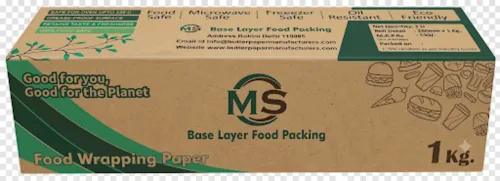
 | food packaging FOIL PAPER [ 2 In 1] (1kg net weight) Foil paper is a high-performance material that combines the strength and versatility of premium paper with the unmatched barrier properties of... View product → |
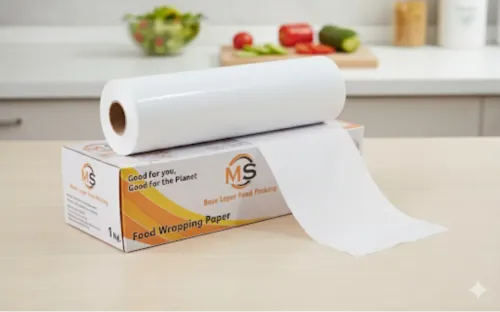
 | Food Packaging foil paper sheet available in customizable size as per customer requirement View product → |
Write a Purchase Specification That Your Equipment Can Actually Use
Put the finished sheet specification on the purchase order, not only in an approved sample. State sheet length and width, dimensional tolerances, squareness, flatness, and the conditioning moisture range; otherwise sheets can misfeed, curl, or lose print registration after storage.
- Material: foil thickness, paper basis weight, total caliper, thickness tolerance, basis-weight tolerance, moisture range, laminate bond strength, and the agreed grease-resistance test, temperature, exposure time, and pass/fail result.
- Cutting: cut tolerance for length and width, maximum corner deviation, and the permitted edge burr or trim variation.
- Packing: exact sheet count per bundle, bundles per carton and pallet, orientation, lot identification, and whether flat sheets interleaved bundles are required.
- Protection: moisture-protective packaging, sealed inner wrapping, pallet cover, and any conditioning period before line use.
| Purchase detail | Specify on the order | Failure if omitted |
|---|---|---|
| Sheet dimensions | Finished size in millimetres and cut tolerance | Misfeeds, waste, or incorrect overlap |
| Squareness and flatness | Maximum diagonal difference and curl limit | Skewed wrapping and feeder jams |
| Material tolerances | Foil gauge, caliper, basis weight, and tolerances | Stiffness, folding, and consumption vary |
| Bundle format | Count, interleaving, pallet pattern, and lot code | Damaged edges and untraceable stock |
Require the supplier’s lot certificate to report actual results, not nominal values. Tie acceptance to the approved sample and your equipment trial.
Control Storage and Accept Each Delivery Against the Approved Sample
Keep cartons sealed in a clean, dry warehouse, off the floor and away from sunlight, water, chemicals, and heat sources. Maintain the supplier’s stated conditioning range; if none is given, record temperature and relative humidity and let cartons equilibrate before production. This limits sheet curl, blocking, adhesive odour, and dimensional change.
Use incoming inspection on a defined sample from each lot. Check:
- Carton labels against the purchase order, including lot number, production date, and shipment reference.
- Sheet count, net weight, dimensions, squareness, and visible sheet curl.
- Foil coverage, pinholes, wrinkles, edge damage, contamination, and delamination.
- Blocking between sheets and any adhesive odour stronger than the approved sample.
- Packaging damage, moisture marks, and evidence of compression.
Accept the delivery only when these results match the approved sample and specification. Record the inspection, retain representative sheets and test records for your stated retention period, and link the finished sheets to the paper lot, foil lot, adhesive or coating batch, production date, and shipment.
Place a lot on hold when any critical defect appears. Reject or obtain written concession for exposed contamination, delamination, missing traceability, unacceptable foil coverage or pinholes, persistent blocking, wrong sheet count or net weight, or performance that changes after conditioning. Notify the wholesaler before using the lot.
Frequently asked questions
What food-contact documents should you request from a foil paper sheet wholesaler?
Request a food-contact declaration for the finished laminate covering the paper, aluminum foil, adhesive, coating, ink, and release treatment. It should identify intended food types, contact conditions, and limitations.
How do you compare foil paper sheet prices accurately?
Convert the quote into delivered cost per usable sheet by including sheet dimensions, basis weights, roll or sheet yield, freight, duties, waste, and rejected material.
What should you test before approving a foil paper sheet wholesaler?
Test production capacity, lead times, minimum order quantities, payment terms, dimensional tolerances, repeat-order controls, and the supplier’s ability to match the approved sample.
What should a purchase specification for foil paper sheets include?
Specify foil thickness, paper grade and basis weight, laminate construction, adhesive or coating, sheet dimensions, tolerances, print or release requirements, core or packing details, and food-contact limits.
How should foil paper sheets be stored and accepted on delivery?
Store them sealed in a clean, dry area away from odors, moisture, heat, and direct sunlight. Check each delivery against the approved sample, documents, dimensions, appearance, quantity, and packaging condition.
Related product
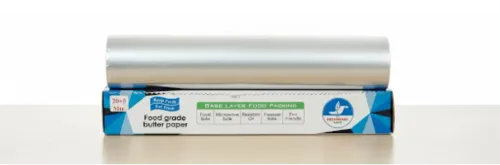
 | Food Packaging Aluminum Foil Paper [2 In 1] One Side Paper One Side Foil Foil paper available in different micron as per customer need View product → |