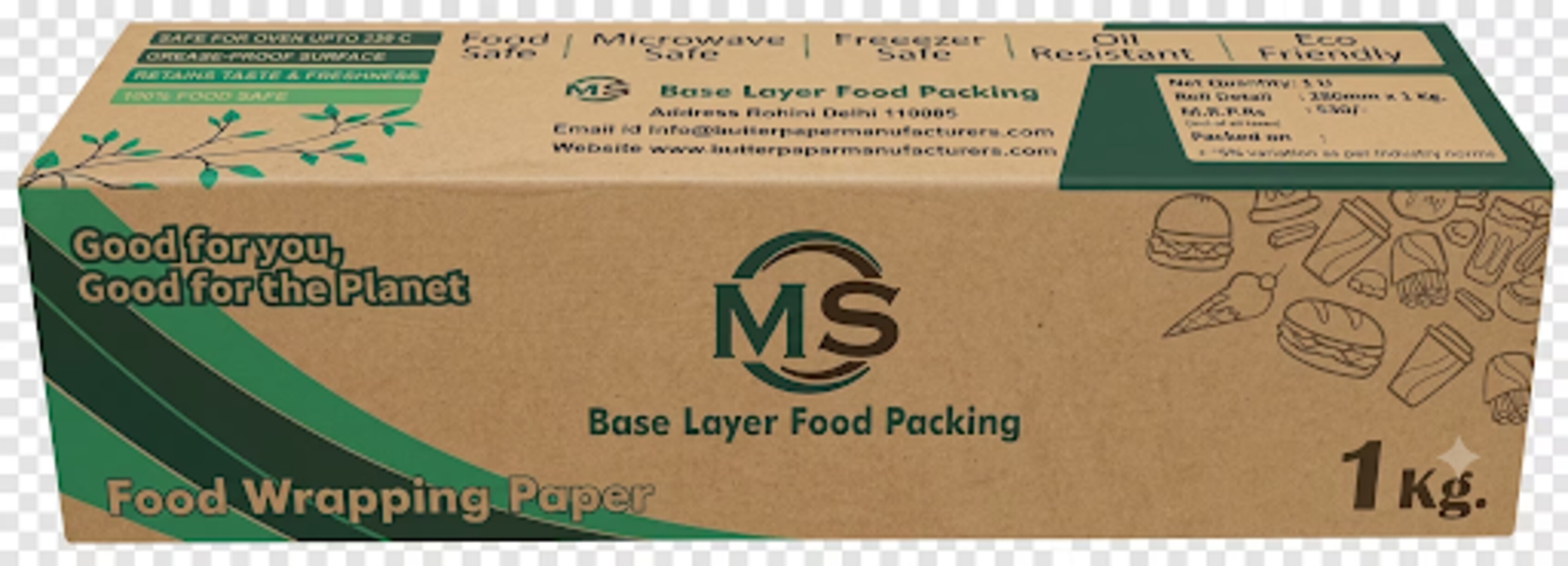
“Butter paper” does not identify one technical material: the name can describe greaseproof paper, parchmentized paper, glassine, coated paper, or a paper-and-foil laminate. By the end, you will have a practical way to specify the format, test the material with your food, verify food-contact documentation, and compare suppliers on operating cost rather than price per kilogram alone.
Key takeaways
- Define the food, pack format and temperature before requesting quotes.
- Choose sheets, rolls or jumbo rolls based on equipment and monthly usage.
- Test grease resistance with your actual food, filling and holding time.
- Request food-contact documents and inspect every repeat-order sample.
Start with the food, pack format and exact material specification
Before contacting a butter paper supplier, define the food, packing format and use conditions. “Butter paper” is a commercial label, not a complete material specification; it can mean greaseproof paper, parchmentized paper, glassine, coated paper or an aluminium-foil laminate.
1. Name the food and portion: croissant, burger, fried snack, sandwich, pastry or high-fat filling. State whether it is hot, cold, oily, wet, sticky, acidic or frozen.
2. Specify the pack format and dimensions: pre-cut sheet, folded wrap, tray liner, bakery-box interleaf, roll-fed wrapper or foil-lined pouch. Give finished length, width, fold lines and required overlap.
3. Write the food packaging paper specification: paper grade, basis weight in GSM, caliper, colour, opacity, coating or parchmentizing, and print requirements. Do not accept “standard butter paper” as the paper grade.
4. Request measured grease resistance with the test method and rating identified. GSM alone cannot predict grease holdout because porosity, fibre formation, sizing and coatings change performance.
5. Include wet tensile strength or wet-strength retention for steam, condensation or aqueous fillings. Ask for the ISO 3781 result; dry tensile strength does not show whether the wrap will disintegrate after contact with moisture.
6. State the food-contact conditions: food type, temperature, contact time, single-use status and destination market. For foil laminates, add laminate bond strength, foil pinholes, flex-crack resistance and finished-pack leak integrity to the quotation request.
Calculate the material you need and choose sheets, rolls or jumbo rolls
Choose the stock format that matches your packing speed, equipment and storage space, then calculate the finished dimensions with overlap and trimming included. For a sandwich, set the sandwich wrapping paper size from the open wrap needed to fold underneath, not from the food’s length alone.
A 300 × 300 mm sheet may suit a small sandwich, while a large burger or filled roll needs a larger blank.
| Option | Best fit | Main trade-off |
|---|---|---|
| Butter paper sheets | Counter wrapping, bakery liners, trays and low-to-medium volumes | Ready to use, but you pay for cutting and store more cartons |
| Butter paper rolls | High-volume wrapping with a dispenser or cutter | Faster and flexible, but requires consistent cutting and roll-compatible equipment |
| Jumbo rolls | Converters producing custom sheets or smaller rolls | Lowest converting cost at scale, but needs rewinding, cutting, lifting and storage space |
Calculate each format from the pack pattern:
- Measure the food footprint, then add the fold-under, side overlap and end flaps. Add 3–5 mm trim allowance where your cutter needs it.
- Multiply the required sheet length by daily portions; add a measured waste allowance from trial runs, not an assumed percentage.
- For rolls, specify web width, roll length, core diameter, winding direction and maximum roll diameter. For jumbo rolls, also specify slit widths and splice limits.
- Approve width, length, squareness, curl and winding hardness by lot. Put those tolerances on the sample and certificate of analysis, because average size alone will not prevent jams.
Compare GSM, grease resistance and construction through application tests
A sheet that passes a grease test can still fail with hot, oily takeaway food. Compare GSM with the paper’s construction, measured grease resistance, wet tensile strength and a trial using your actual food.
| GSM | Construction and result | Best evidence |
|---|---|---|
| Lower GSM | Uses less material but can tear, wrinkle or turn translucent under oil; judge it with a filled-pack trial | Test folding, lifting and stacking |
| Higher GSM | Feels stiffer and resists handling damage, but does not guarantee grease resistance; porosity and coatings matter more | Request grease-resistance data, not GSM alone |
| Greaseproof or parchmentized paper | Dense fibre structure supports grease holdout; performance depends on the grade and process | Check the TAPPI T 559 Kit test method and rating |
| Coated paper or paper/foil laminate | Adds a barrier for demanding oily or wet foods, but folding and sealing can expose weak points | Test seams, corners and creases |
| Uncoated paper | Suits dry foods better; oil or sauce can migrate through pores | Run a timed contact test |
The TAPPI T 559 Kit test rates penetration from 1 to 12; a higher number means greater resistance to the test liquids. It does not predict every sauce, temperature or pressure condition. Do not substitute a Cobb water-absorption result for grease resistance.
Ask for wet tensile strength or wet-strength retention when the sheet touches steam, condensation or wet fillings. ISO 3781 is a recognised wet-strength method.
- Heat the food, wrap it, stack it and hold it for the intended serving time.
- Check oil spots, softened folds, tearing, sticking and leakage.
- Repeat with the heaviest portion and the sharpest or wettest filling.
Verify food-contact compliance and restrictions for heat, cold and high-fat foods
Ask for a food-contact declaration covering the finished construction, not just the paper substrate. It must identify the paper, coating, foil, ink, varnish and adhesive, then state the permitted food type, contact temperature, contact time and repeated-use status.
Request these documents and checks:
- Evidence that the U.S. construction fits FDA 21 CFR 176.170 for aqueous and fatty foods, or 21 CFR 176.180 for dry foods.
- Evidence that the EU construction meets EU Regulation 1935/2004 and is manufactured under Regulation 2023/2006 good manufacturing practice.
- Migration testing or a documented risk assessment for the finished article, including inks, coatings, adhesives, recycled-fiber contaminants and printed-surface set-off.
- The test method and conditions behind any grease rating. A TAPPI T 559 Kit result does not prove performance against hot oil, stacked-food pressure or condensation.
- Wet tensile strength or wet-strength retention for steam, wet fillings and hot food; ISO 3781 is one recognised test method.
Use limits must match the job:
| Use condition | Evidence to confirm | Risk if missing |
|---|---|---|
| Hot, fatty food | Declaration and migration testing at the stated temperature and time | Grease and migrants can pass into food |
| Cold or frozen food | Temperature range, condensation and storage-contact limits | Paper can weaken, crack or delaminate |
| Dry food | FDA 21 CFR 176.180 or equivalent declaration | A fatty-food approval may not cover this use |
Ask the supplier to state whether the approval covers single use, repeated use, folding and direct food contact. “Butter paper” alone proves none of these limits.
Use a supplier approval checklist before placing a repeat order
Approve a supplier only after its sample passes your actual packing process and its records let you identify every later lot. Do not approve a single attractive sheet and assume production will match it.
Compare suppliers against identical evidence:
| Comparison point | What to request | Why it matters |
|---|---|---|
| Dimensional control | Width, length, squareness, curl, core dimensions, winding hardness and splice frequency | Prevents jams, skew and feed problems |
| Material performance | GSM, named grease-resistance method, wet tensile strength or wet-strength retention | Predicts handling after contact with oil, steam or condensation |
| Process compatibility | Results from your wrapper, interfolder or heat-sealer | A laboratory rating cannot prove reliable converting |
| Documentation | Certificate of analysis, lot number, production date and retained sample | Creates accountability for each delivery |
Use this supplier checklist for the approval sample:
- Run sheets or rolls at normal machine speed and record tearing, skew, seal failure and cutting waste.
- Test the finished pack with hot oil, condensation, stacked-food pressure and the longest intended contact time.
- If the paper has silicone, test release, printing, adhesive bonding and heat sealing together.
- Record approved dimensions, tolerances, GSM and maximum splice frequency.
For repeat orders, require lot-based sampling instead of trusting the first sample. Check measurements and appearance on arrival, quarantine failures, and link retained samples to batch traceability. Baselayer Food Packing should be assessed on this evidence rather than on a catalogue description.
Related products
 | Food Packaging ₹135 available in different sizes and different gsm View product → |
 | Food Packaging Butterpaper sheet available in customizable size as per requirement View product → |
Frequently asked questions
What should you specify before contacting a butter paper supplier?
State the food, pack format, sheet or roll dimensions, folding or wrapping method, temperature range, contact time and grease level. Ask the supplier to identify the material as greaseproof paper, parchmentized paper, glassine, coated paper or aluminium-foil laminate.
How do you choose between butter paper sheets, rolls and jumbo rolls?
Choose pre-cut sheets for manual packing and consistent piece sizes, rolls for wrapping equipment or variable lengths, and jumbo rolls when you have converting equipment or need high-volume production. Compare usable output, trimming waste, setup time and storage space.
How can you test butter paper for grease resistance?
Pack the actual food at its serving temperature, hold it for the intended time, then inspect the food-facing surface, reverse side, seams and the outer pack. Record oil staining, softening, tearing, sticking and leakage rather than relying on GSM alone.
What food-contact documents should you request from a butter paper supplier?
Request the material specification, food-contact declaration, certificate of analysis or test report, batch traceability details, and any restrictions for hot, chilled, frozen, acidic or high-fat foods. For Indian operations, ask for the supplier’s FSSAI licence details and relevant conformity documents.
Related products
 | Food Packaging Butterpaper roll 50 gsm to 60 gsm available View product → |
 | Food Packaging ₹130 available in different sizes and gsm View product → |
 | Butterpaper Butterpaper Roll 1kg Net Weight Butterpaper 1kg net weight (45 GSM) 900 gram paper 100 gram core with box View product → |
 | Butterpaper Butterpaper roll available in 1kg View product → |