A commercial kitchen cannot plan foil supply by kilogram alone: it must connect meal volume, portion dimensions, shift patterns, dispenser capacity, and storage limits to a usable sheet or roll specification. By the end, kitchen managers will be able to estimate consumption, match each task with the right material, set technical requirements, and evaluate whether a manufacturer can support reliable food-safe production.
Key takeaways
- Calculate foil use by item, portion, dimensions, and shift.
- Specify foil gauge, roll width, length, core, and tolerance before ordering.
- Choose laminates when grease control, handling strength, or printed branding matters.
- Test seals, temperatures, storage conditions, and line speed with production samples.
Calculate daily consumption from portions, dimensions, and shifts
Calculate daily foil consumption by shift, not from a monthly average. For each menu item, record the meal count, portion size, and wrapping dimensions: length × width gives area per piece; multiply by pieces per shift, then total all shifts.
Add separate areas for tray lining, pan covering, portioning, takeaway wrapping, freezer storage, and damaged sheets. Convert area to kilograms using the supplier’s declared basis weight in kg/m²: area × kg/m² = theoretical foil weight. If the supplier provides gauge and density instead, request the declared basis weight rather than estimating it.
- Record foil usage by shift for at least one production week, separating hot food, chilled preparation, delivery, and cleaning or lining tasks.
- Add purchasing allowances for trim, overlaps, tears, roll-end waste, changeovers, and damaged sheets; size the final order against the busiest expected day, not the average day.
- Compare the result with roll length, sheet count, dispenser capacity, maximum roll weight, and storage space. A two- or three-shift kitchen needs enough material at each handover.
| Figure | Calculation | Use |
|---|---|---|
| Theoretical requirement | Total area × basis weight | Measures planned food contact |
| Purchasing requirement | Theoretical weight + operating allowances | Sets the order quantity |
| Peak-shift requirement | Busiest shift’s actual usage | Tests replenishment and dispenser capacity |
Match foil and alternative materials to the kitchen task
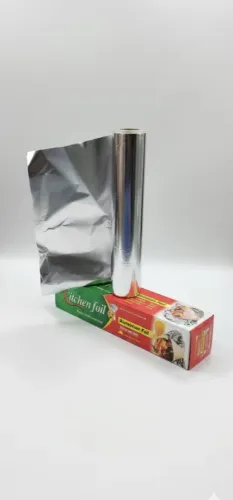
Use aluminum foil for hot-meal wrapping, pan covers, tray lining, portioning, takeaway service, short-term transport, baked-goods holding, and freezer storage. It folds tightly, blocks light, retains heat, and resists grease, but it does not provide visibility or automatic heat-seal performance.
| Material | Best fit | Limits to check |
|---|---|---|
| Aluminum foil | Hot food, freezer packs, pans, trays, baked goods | Punctures, exposed metal in microwaves, acidic or salty contact |
| Foil-paper laminate | Greasy takeaway foods, wraps needing stiffness and fold retention | Bond strength, wet strength, seal layer, disposal complexity |
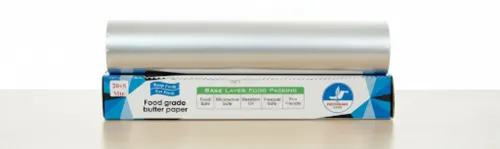
| Butter paper or greaseproof paper | Bakery wrapping and dry-to-moderately greasy portions | Measured grease resistance, moisture resistance, heat resistance, PFAS status |
| Plastic film alternative to foil packaging | Chilled food, transparent inspection, tight overwrap | Heat limit, puncture resistance, oxygen and moisture barrier, sealing method |
| Reusable containers | Repeated transport, sauces, long service cycles | Washing capacity, return rate, storage space, lid seal |
Butter paper versus greaseproof paper is not a reliable performance comparison: trade names do not establish porosity, wet strength, or oily-filling resistance. Test the actual food after heating or refrigeration, because grease resistance does not prove wet strength or heat-seal integrity.
Do not use bare foil against tomato, citrus, vinegar-rich, brined, or heavily salted food held hot or for long periods; specify coated foil or a laminate. Reject exposed foil for microwave heating, opaque packs where inspection matters, and long storage unless the complete pack has validated barrier and shelf-life data.
Choose the least complex material that protects the food, suits the sealing method, and follows the kitchen’s disposal or reuse route.
Set foil gauge, format, and converting specifications before ordering
Choose the format around the equipment, not the price per kilogram. Thinner foil reduces material consumption and folds easily, but foil thickness and puncture resistance trade off: thin foil is more vulnerable to pinholes, punctures, tears, stretching, and forming damage. An 11-micron description alone cannot define suitability.
1. Set the performance requirement. Request a maximum pinhole count or named inspection method, plus tensile or tear data where relevant. Require performance testing after actual converting, not only tests on incoming foil.
2. Match dimensions to the task. Choose foil roll width and sheet length for tray dimensions, prep benches, dispensers, and wrapping stations. A kilogram price hides waste when the width forces trimming or the length causes frequent changes.
3. Put these roll requirements on the purchase order: finished web width, outside diameter, core inside diameter and length, winding direction, maximum roll weight, splice construction, roll hardness, and unwind-tension limits. These are core diameter and converting specifications, not optional handling details.
4. For pre-cut sheets, specify sheet count and pack size, stack height, sheet dimensions, and dispenser fit. Confirm that the stack feeds without curling or jamming.
5. Run the exact foil through the slitter, rewinder, dispenser, or wrapping machine before approval. Check slitting dust, curl, blocking, telescoping, web breaks, and feed accuracy.
Poor slitting or rewinding can create labour-heavy stoppages even after a basic laboratory pass. Curl, telescoping, and excessive roll weight cause misfeeds, difficult lifting, extra roll changes, and damaged sheets.
Choose a laminate when handling, grease control, or branding demands it
Choose a paper-and-foil laminate when single-layer foil slips, tears, loses its fold, or cannot carry the brand and handling instructions. The foil-paper laminate benefits are greater stiffness, fold retention, grease control, and printability, but disposal becomes harder when layers do not separate.
| Construction | Moisture and grease | Handling and branding | Disposal |
|---|---|---|---|
| Single-layer foil | Strong moisture and light barrier; grease performance depends on contact and food chemistry | Folds easily but can tear; limited direct printability | Simpler metal recovery |
| Paper-and-foil laminate | Better handling and grease control when correctly specified | Stiffer, easier to wrap and print; harder to separate | More complex recycling |
| Paper alone | Moisture resistance varies; grease protection needs measured evidence | Light, printable, and easy to handle | Simpler fibre route if uncontaminated |
Do not treat butter paper, greaseproof paper, parchment, glassine, and coated paper as interchangeable. Request measured grease resistance, wet strength, porosity, heat resistance, and sealability for the actual food, including hot fat, sauce, or oily filling.
Before purchase, verify:
- The heat-seal layer for foil packaging: PE, PP, ionomer, or heat-seal lacquer, plus dwell time, pressure, temperature, contamination tolerance, and line speed.
- Food-contact compliance for the paper, adhesive, coating, primer, and ink—not aluminium alone.
- For EU supply, a Declaration of Compliance stating food type, temperature, contact duration, and migration or compositional evidence.
- An explicit statement on intentionally added PFAS for paper-based wraps.
Baselayer Food Packing can add practical value by supplying a tested construction matched to the kitchen’s food, sealing equipment, and target-market documentation.
Related products
 | food packaging FOIL PAPER [ 2 In 1] (1kg net weight) Foil paper is a high-performance material that combines the strength and versatility of premium paper with the unmatched barrier properties of... View product → |
 | Food Packaging Aluminum Foil In 11 Micron 1kg Aluminum foil available in 11 micron 1kg View product → |
Validate temperature, storage, and real production-line performance
Record the actual use conditions before approving hot holding and reheating foil. “Heat-safe” is not a test result: write the exact temperature range, contact time, food composition, moisture level, heating method, cooling cycle, freezer storage and short-term transport duration.
1. Test the finished pack through baking, hot holding, chilling, freezing, reheating, and transport using the real food. Include hot, wet, acidic, and salty products; tomato, citrus, vinegar-rich, brined, or heavily salted foods can corrode bare foil or transfer metal when heat and moisture extend contact time.
2. Treat microwave use as a separate validation. Exposed foil, foil edges, folds, metallic inks, or contact with the oven cavity can arc. Approve an aluminum-containing pack as microwave-safe only for a named configuration with written operating instructions.
3. Require a complete barrier specification for long storage: foil gauge, maximum pinhole count or inspection method, laminate quality, and shelf-life evidence. A thinner foil with handling damage is not a reliable barrier.
4. Complete supplier qualification and production-line testing after slitting, rewinding, printing, die-cutting, adhesive curing, and storage. Check adhesive cure, bond strength, coefficient of friction, blocking, curl, seal strength after refrigeration or reheating, splice behaviour, roll changes, and line speed with the actual food.
Start with a controlled first order. Retain samples by batch, record complaints against lot numbers, and approve the supplier only after the finished construction survives the kitchen’s workflow. Include foil temperature limits and the specified heat-seal layer where machine sealing is used.
Frequently asked questions
How do you calculate daily aluminum foil consumption in a commercial kitchen?
Record each menu item’s portions per shift, then multiply the foil length by width to find area per piece. Multiply that area by pieces per shift and add the totals for every item and shift.
How do you choose between aluminum foil, greaseproof paper, butter paper, and foil laminate?
Match the material to the task. Use foil for heat resistance, light protection, and a strong moisture barrier; use greaseproof or butter paper for direct food wrapping and grease control; choose a laminate when handling strength, branding, or combined barrier performance matters.
Which aluminum foil specifications should you confirm before ordering?
Confirm foil gauge or thickness, roll or sheet format, width, length, core diameter, winding direction, cutting tolerance, alloy or temper, and the required food-contact documentation.
When is an aluminum foil laminate better than plain foil?
Choose a laminate when the package needs improved stiffness, easier handling, grease control, printable branding, or a paper surface for writing and folding.
How should a kitchen validate foil before full-scale production?
Run production samples at operating line speed and check wrapping, folds, seals, tearing, temperature exposure, cold storage, condensation, grease migration, and storage durability.
Related products
 | Food Packaging Aluminum Foil Paper [2 In 1] One Side Paper One Side Foil Foil paper available in different micron as per customer need View product → |
 | Food Packaging foil paper sheet available in customizable size as per customer requirement View product → |